Detailed Notes
The Golden Langur is revered by local communities and is considered a sacred animal in many areas. Its discovery in Assam in 1953 by E.P. Gee brought global attention to this rare species, which remains restricted to a small geographic region.
1. What Is the Golden Langur?
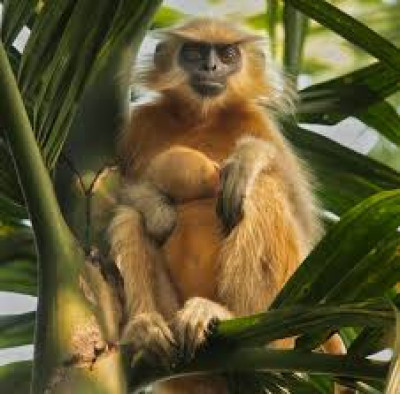
The Golden Langur is a rare leaf-eating monkey species belonging to the colobine group of primates. Scientifically known as Trachypithecus geei, it is famous for its bright golden coat that appears to glow in sunlight, making it one of the most visually striking primates in India.
Adult males typically have darker golden fur on their flanks, while females and juveniles have lighter, silvery-white shades. All individuals have black faces and long tails, which help them balance while moving through trees.
2. Where Is the Golden Langur Found in Assam?
The Golden Langur is mainly found in western Assam, particularly in forested areas between the Manas River and the Sankosh River, along the Assam-Bhutan border. It is also found in parts of southern Bhutan, making its global range extremely limited.
In Assam, its key habitats include:
-
Chakrashila Wildlife Sanctuary
-
Forest patches near the Bhutan border
Because of habitat fragmentation, Golden Langur populations now survive in small, isolated forest areas, making conservation efforts critical.
3. Physical Features and Identification
The Golden Langur is easily identified by:
-
Bright golden-orange fur
-
Black face and expressive eyes
-
Long tail used for balance
-
Slim body adapted for tree life
Males usually appear darker golden, while females and juveniles look lighter and sometimes silvery-white. These features make the Golden Langur one of the most distinctive primates in the Indian subcontinent.
4. Habitat and Behavior
Golden Langurs are strictly arboreal, meaning they spend almost their entire lives in trees. They rarely come down to the ground and move through the forest canopy in social groups.
They are:
-
Herbivorous, feeding mainly on leaves, fruits, flowers, and seeds
-
Shy and quiet, avoiding human interaction
-
Group-living, usually seen in family troops
Their dependence on continuous forest canopy makes them especially vulnerable to deforestation and habitat fragmentation.
5. Conservation Status and Threats
The Golden Langur is classified as Endangered due to:
-
Deforestation
-
Habitat fragmentation
-
Linear infrastructure such as roads and power lines
-
Shrinking forest corridors
Its extremely restricted distribution in western Assam and Bhutan makes it one of India's most vulnerable primate species.
6. Conservation Efforts in Assam
Important conservation areas protecting the Golden Langur include:
-
Chakrashila Wildlife Sanctuary, the only sanctuary created specifically to protect this species
-
Manas National Park, a UNESCO World Heritage Site
Local awareness programs and habitat protection initiatives aim to preserve remaining forest corridors and prevent further decline of this rare animal.
7. Why Is the Golden Langur Important?
The Golden Langur plays a vital role in maintaining forest ecosystems by helping in seed dispersal and vegetation balance. Its presence also highlights the ecological richness of Assam's forests and the importance of protecting fragile wildlife habitats.
Conclusion
Assam is famous for being the natural home of the Golden Langur, one of India's rarest and most endangered primates. Found mainly in western Assam near the Bhutan border, this beautiful golden-furred monkey is known for its arboreal lifestyle, sacred status among locals, and extremely limited distribution. Protecting the Golden Langur is essential for preserving Assam's biodiversity and forest ecosystems.