Detailed Notes
Feral Horses in Assam: Origin, Habitat, Threats and Conservation Status
These horses have survived in the wetlands and grasslands of upper Assam for nearly eight decades, facing floods, habitat loss, and human interference while maintaining their natural herd structure and survival instincts. Their story combines history, ecology, and urgent conservation challenges.
What Are Feral Horses?
A feral horse is a horse that descends from domesticated stock but lives freely in the wild without human control. Unlike truly wild species such as the Przewalski's horse of Central Asia, feral horses originate from domestic animals that escaped, were abandoned, or were released into open environments and later adapted to survive and reproduce independently.
Over time, feral horses lose domesticated behavioral traits and begin to display instincts closer to wild animals. In Assam, these horses are extremely shy and avoid human presence entirely. Some horse populations elsewhere are described as semi-feral when they are occasionally handled or managed by people, but the horses of Dibru-Saikhowa are fully feral and live without human interaction.
Location of Feral Horses in Assam
Feral horses in Assam are found only inside Dibru-Saikhowa National Park, which spreads across the Dibrugarh and Tinsukia districts. This national park is located along the floodplains of the Brahmaputra and Lohit rivers and is known for its wetlands, tall grasslands, forest patches, and riverine sandbars locally called chaporis.
The horses prefer open grassy plains near water sources where grazing is abundant. During floods, they move to elevated sandbars and forested areas to survive rising water levels.
Origin and History
The most widely accepted theory regarding the origin of feral horses in Assam traces them back to World War II. During the war, Allied forces reportedly stationed cavalry horses in the region. When military camps were abandoned, several horses were left behind, eventually escaping into nearby forests and grasslands. Over generations, these horses adapted to the wild and established stable breeding populations.
Another theory suggests a possible link to Przewalski's horses, an endangered wild horse species native to Central Asia and China. However, this theory lacks scientific confirmation, and historians and conservationists largely accept the World War II lineage explanation as the most credible.
These horses have been living in Dibru-Saikhowa for nearly 80 years, surviving independently without domestication or breeding programs.
Physical Appearance
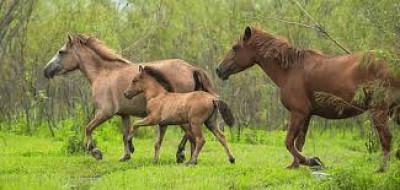
Feral horses in Assam have a stocky and muscular build suited for wetland terrain and seasonal flooding. Their coats range in color from white to chestnut, brown, and light grey. Their strong legs, broad chests, and thick necks help them move efficiently through swampy grasslands and river plains.
Unlike domesticated horses, these animals display minimal tolerance toward humans and rarely allow close observation, making photography and research difficult.
Behavior and Social Structure
These horses live in small herds, usually consisting of 3 to 5 individuals, although some groups may grow as large as 15. Each herd typically includes a dominant stallion, several mares, and their offspring. The horses are highly alert, cautious, and quick to flee when sensing danger.
They behave similarly to wild animals, avoiding human settlements and rarely approaching villages or roads. Their daily activities revolve around grazing, drinking water, resting, and guarding young foals from predators or disturbances.
Habitat and Ecology
The habitat of feral horses in Assam includes:
-
Floodplain grasslands
-
Wetland marshes
-
River islands and chaporis
-
Forest fringes near water bodies
These ecosystems provide fresh grasses and aquatic vegetation that sustain the horses throughout the year. However, seasonal flooding plays a major role in shaping their survival patterns. During heavy monsoons, rising water levels often submerge grazing grounds, forcing herds to relocate to higher areas or sandbars.
The horses play a role in maintaining grassland ecology by grazing and dispersing seeds, contributing to habitat balance within the park.
Conservation Status and Legal Protection
Despite their uniqueness, feral horses in Assam are not classified as wild animals under the Wildlife Protection Act of 1972. This legal gap leaves them without formal protection under India's primary wildlife law. As a result, conservation measures for them remain limited and inconsistent.
There is also no officially conducted population census, making it difficult to assess their exact numbers, health status, or population trends.
Recently, the National Green Tribunal (NGT) raised serious concerns about their survival. The tribunal highlighted the absence of conservation planning, lack of legal safeguards, and possible violations of the Biodiversity Act and Environment Protection Act. It urged authorities to take immediate steps to protect the remaining horses before their population declines further.
Major Threats to Feral Horses in Assam
Several factors threaten the survival of this rare population:
1. Flooding
Annual floods in the Brahmaputra basin destroy grazing grounds and isolate herds. Many horses drown or die from starvation when trapped on submerged land patches.
2. Habitat Loss
Encroachment, shrinking grasslands, and ecological changes reduce available grazing areas, forcing horses into smaller and fragmented habitats.
3. Illegal Smuggling
There have been reports of horse smuggling for labor and trade purposes, posing a direct risk to already declining populations.
4. Competition with Livestock
Domestic cattle grazing inside protected areas competes for food resources, affecting nutrition and breeding success among feral horses.
5. Lack of Legal Protection
Since these horses are not recognized under wildlife law, there is no structured conservation plan or enforcement framework to ensure their safety.
Why Feral Horses of Assam Are Unique
Feral horses in Dibru-Saikhowa are the only known free-roaming horse population in India. Their ability to survive independently in floodplains, wetlands, and forest ecosystems without human management makes them ecologically significant.
Globally, most feral horse populations exist in Australia, North America, and parts of Europe. Assam's horses stand out due to their geographic isolation, tropical floodplain habitat, and cultural association with World War II history.
Their survival also highlights nature's capacity for adaptation, showing how domesticated animals can rewild successfully under suitable environmental conditions.
Conservation Challenges and the Way Forward
Protecting feral horses in Assam requires:
-
Legal recognition under wildlife or biodiversity laws
-
Regular population surveys and health monitoring
-
Protection from smuggling and illegal capture
-
Habitat restoration and controlled livestock grazing
-
Disaster response plans during floods
Without intervention, these horses face a serious risk of extinction. Conservationists emphasize that preserving this unique population is not just about saving animals but also about protecting Assam's ecological heritage and historical legacy.
Summary
Feral horses in Assam are free-roaming descendants of domesticated horses believed to have originated during World War II. Found exclusively in Dibru-Saikhowa National Park, they inhabit grasslands, wetlands, forests, and river sandbars. They live in small herds, avoid humans, and display wild behavioral patterns. Despite their uniqueness, they lack legal protection and face threats from floods, habitat loss, smuggling, and competition with livestock. Recent concern by the National Green Tribunal highlights the urgent need for conservation action to ensure their survival.