In Depth
The Ahom dynasty ruled Assam for nearly six centuries and left behind a remarkable legacy of monuments, temples, tanks and burial structures. Raja Maidam is part of this heritage and is particularly associated with Swargadeo Purandar Singha, regarded as the last Ahom king. His cremation took place in 1894, and the maidam became a memorial associated with his remains. The site is also traditionally linked with other members of the Ahom royal family, including King Kameswar Singha.
The term 'maidam' refers to the burial monuments associated with members of the Ahom royal and noble families. These structures are an important feature of Ahom heritage and reflect the traditional funerary customs and respect given to the deceased members of the royal household.
History of Raja Maidam
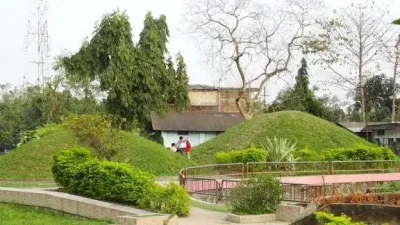
Raja Maidam, also known as Rajamaidam, is an important historical site in Jorhat that preserves the memory of the final phase of Ahom royal history. The name Rajamaidam is now associated with a wider locality of Jorhat city, but its origin is connected with the royal burial mounds of the last Ahom rulers. The site presently has two maidams, the larger one associated with Swargadeo Purandar Singha and the smaller one with his son, Swargadeo Kamaleswar Singha.
Swargadeo Purandar Singha had a remarkable and turbulent reign. He first became king when his father, Brajanath Gohain, was considered physically unable to govern. His reign was later disrupted by the Manipuri invasion, during which Purandar Singha left the Ahom kingdom and took refuge in British-controlled territory. Chandrakanta Singha was subsequently placed on the Ahom throne by the Manipuris.
After the British forces drove the Manipuris out of Assam, Purandar Singha was restored as king. His restoration came with an agreement requiring him to pay a tribute of fifty thousand rupees to the British, known as lalbandi. This made Purandar Singha the first Ahom ruler to govern Assam as a tributary king under British authority.
Purandar Singha was eventually removed from power when he failed to meet the required tribute. In 1838 AD, corresponding to 1760 Saka, the British ended his rule and established the administrative districts of Sivasagar and Dibrugarh in Upper Assam. Although the government offered Purandar Singha a pension after his deposition, both he and his son Kamaleswar Singha reportedly declined the offer.
Swargadeo Purandar Singha died on 1 October 1846 at his palace in Jorhat. Historical accounts associate his death with the period of the autumn Durga Puja celebrations, when people across the kingdom were occupied with the festival. Despite having been removed from the throne years earlier, Purandar Singha continued to be respected by many of his followers and subjects. Following his death, the nobles recognized his son Kamaleswar Singha as his successor.
According to traditional accounts, elaborate royal funeral rituals were performed after Purandar Singha's death. His body was ceremonially bathed using water associated with gold, silver, copper and brass vessels before the final rites. After members of the royal family paid their respects, his cremation was carried out on a sandalwood pyre near the Bhogdoi River. His ashes were subsequently placed at the royal burial ground near present-day JB Road, following the Ahom tradition of constructing maidams for members of the royal family.
This burial site gradually came to be known as Raja Maidam or Rajamaidam. According to Ahomar Din, Purandar Singha's maidam was constructed in 1847, while the maidam of his son Kamaleswar Singha was built in 1853. Kamaleswar Singha died a few years after his father and was also buried at the same royal memorial site.
Today, the two surviving maidams stand as reminders of the closing period of Ahom royal history in Assam. The larger mound commemorates Purandar Singha, while the smaller structure is associated with Kamaleswar Singha. The historical importance of the site has also influenced the surrounding area, with a large part of Jorhat becoming known as Rajamaidam and the connecting road from AT Road being popularly called Rajamaidam Road.
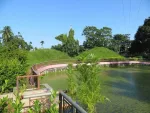
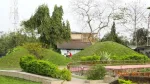
Today, Raja Maidam is surrounded by a peaceful green environment that has been developed as a public park. Visitors can walk around the landscaped area, spend time near the open spaces and observe the historic memorial while learning about the royal history of Assam. Its relatively quiet setting makes it different from the busier attractions in Jorhat city.
Raja Maidam is also conveniently located within Jorhat, making it easy to include in a local sightseeing itinerary. Visitors can reach the site by auto-rickshaw, taxi or private vehicle from different parts of the city. Jorhat Town Railway Station is the nearest major railway connection, while Jorhat Airport at Rowriah provides access for travellers arriving by air.
October to March is generally a comfortable period to visit Jorhat and explore its outdoor historical attractions. The site can be visited along with other Ahom-era monuments and cultural destinations in and around Jorhat.
For travellers interested in Assam history, Ahom architecture and royal heritage, Raja Maidam offers a quiet and meaningful glimpse into the final chapters of the Ahom dynasty. The memorial continues to connect present-day Jorhat with the royal traditions and historical legacy of one of Assam's most influential dynasties.