In Depth
The site contains stone architectural remains believed to date to the 10th-11th century CE. Its surviving temple foundation, carved stone features, sculptural fragments and other architectural elements provide valuable clues about early medieval religious architecture in Assam. Although much of the original structure is no longer intact, the remains offer an opportunity to understand how historical monuments can preserve important evidence even after centuries of exposure and deterioration.
For history enthusiasts, archaeology students and travellers interested in discovering lesser-known heritage destinations, Baman represents an intriguing part of Assam's past.
Where Is the Baman Archaeological Site Located?
The Baman Archaeological Site is situated at Bejar Pather in Darrang district, Assam, India. Its location makes it part of the wider historical landscape of northeastern India, a region known for its distinctive cultural traditions, religious monuments and architectural influences.
Unlike well-known tourist attractions that draw large numbers of visitors, Baman is a relatively lesser-known archaeological destination. Its importance lies primarily in the surviving historical evidence rather than in modern tourism infrastructure.
Visitors interested in exploring the site should confirm the precise access route, local road conditions and any visiting restrictions before travelling. It is also advisable to consult the Assam Directorate of Archaeology or the relevant local authorities for current information about the site's management and accessibility.
Historical Background: Tracing Assam's Early Medieval Past
The stone remains at Baman are dated to approximately the 10th-11th century CE. This period forms part of the early medieval history of Assam, when religious institutions, regional political powers and artistic traditions contributed to the development of the Brahmaputra Valley's cultural landscape.
Temple architecture from this broad historical period can reveal information about religious beliefs, construction methods, artistic preferences and the communities that supported places of worship. Even when a temple has disappeared, its foundation, decorative stones and sculptural fragments may help archaeologists reconstruct aspects of its original design.
At Baman, the surviving architectural features suggest that the location was associated with an important religious structure. The precise historical circumstances surrounding its construction, patronage and eventual decline require further archaeological evidence. Therefore, the site's age and architectural remains are useful starting points for historical interpretation, rather than grounds for making unsupported claims about its founders or original appearance.
The remains also contribute to the broader understanding of Assam's connections with architectural traditions found elsewhere in eastern India. Such comparisons need to be based on documented archaeological study, including the site's construction techniques, decorative motifs and sculptural characteristics.
Important Archaeological Features of Baman
The Baman Archaeological Site is notable for several surviving stone elements. Together, these features provide clues about the design and possible religious function of the original structure.
1. Square-Shaped Temple Plinth
One of the principal features identified at the site is a square-shaped temple plinth. A plinth forms the raised foundation or supporting base of a building and can be particularly important when the upper portions of a temple have disappeared.
The shape and arrangement of a temple foundation can help researchers understand the structure's original ground plan. At Baman, the surviving plinth is an important piece of evidence for identifying the remains as part of an ancient temple complex.
Although the foundation offers clues about the monument's layout, its complete original dimensions and architectural arrangement should not be assumed without a detailed archaeological survey.
2. Pranala: An Ancient Water Outlet
Another significant feature is a pranala, a water outlet or drainage component associated with certain temple structures. In traditional temple architecture, such an element could help channel water away from a designated area used for ritual purposes.
Its presence at Baman provides an additional clue about the possible religious function of the structure. Architectural details of this kind can help distinguish a temple from other types of historical buildings, although their interpretation depends on the context in which they are found.
The pranala is therefore an important feature for anyone studying the site's original design and ritual associations.
3. Biswapadma or Double-Lotus Motif
The site also preserves a Biswapadma motif, described in the reference material as a double-lotus design. The lotus is a recurring symbol in the religious art and architecture of South Asia and appears in a variety of decorative and sacred contexts.
Lotus motifs may be used in architectural ornamentation, sculptural compositions and the design of temple components. Their presence can contribute to the interpretation of a monument's artistic vocabulary.
At Baman, the Biswapadma detail adds to the site's architectural interest. However, a motif on its own does not establish the identity of the deity worshipped at the original temple.
4. Elephant Carving on the Rock Surface
An elephant carving on the rock surface is another feature associated with the archaeological remains. Elephants have held cultural, religious and artistic significance across many South Asian traditions, appearing in sculpture, decorative art and representations connected with royal or sacred settings.
The carving contributes to the site's visual and archaeological character. Its precise meaning, date and relationship to the temple would require closer examination of its style, placement and surrounding evidence.
For visitors, the carving is a reminder that even small surviving details can help researchers investigate the artistic traditions of an earlier period.
5. Scattered Stone Relics and Sculptural Fragments
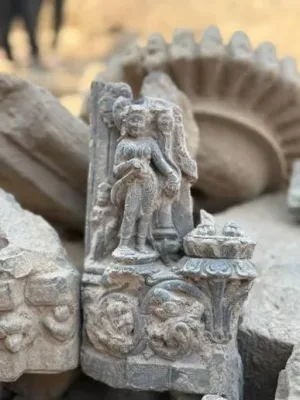
The remains at Baman include scattered stone relics and sculptural fragments. These materials are valuable because they may preserve details that are no longer visible in the surviving foundation.
Archaeologists can study the shape, carving style, stonework and decorative patterns of such fragments to compare them with other monuments. Their original positions and associations, when documented, can also help reconstruct the arrangement of a historical site.
The fragments at Baman should be understood as parts of an archaeological record rather than isolated decorative objects. Preserving their context is essential for future study.
6. Architectural Columns and Mutilated Amalakas
Architectural columns and damaged or mutilated amalakas are also reported among the site's remains. An amalaka is a ribbed, disc-shaped architectural element traditionally associated with the upper portion of certain Hindu temples, particularly the superstructure above the sanctuary.
Such components can provide information about a temple's original elevation and decorative design. When examined alongside the foundation and other stone elements, they may help researchers develop a more complete picture of the structure.
The damaged condition of these remains also highlights the challenges involved in conserving archaeological monuments. Documentation and appropriate protection are important to prevent further loss of historical evidence.
What Do the Remains Tell Us About the Original Temple?
The combination of a square temple plinth, pranala, lotus ornamentation, elephant carving and other architectural fragments suggests that Baman was associated with an ancient religious structure.
The architectural arrangement and decorative elements may also point to connections with wider eastern Indian temple traditions. However, similarities in design do not necessarily establish a direct connection with a particular kingdom, dynasty or architectural school. Such conclusions require reliable archaeological documentation and comparative research.
The reference material suggests that the temple may have been dedicated to a goddess. This remains a possible interpretation rather than a confirmed identification based solely on the features described here. Establishing the deity's identity would require stronger supporting evidence, such as identifiable sculptures, inscriptions or authoritative archaeological findings.
These distinctions are important because archaeological sites often contain incomplete evidence. Careful interpretation allows researchers to recognise the significance of surviving remains without overstating what they reveal.
Archaeological and Cultural Significance
The Baman Archaeological Site is important because it adds to the documented heritage of Darrang district and the wider historical landscape of Assam.
First, its architectural remains provide evidence of historical temple construction in the region. Foundations, drainage features, carved motifs and architectural components can help researchers understand how religious buildings were designed and decorated.
Second, the site offers an opportunity to study the artistic vocabulary of early medieval Assam. Decorative elements such as lotus motifs and elephant carvings can be examined alongside comparable features from other archaeological locations to identify similarities and regional variations.
Third, Baman highlights the importance of lesser-known heritage sites. Popular monuments often receive greater public attention, while smaller archaeological locations may remain unfamiliar to many residents and visitors. Documenting such places helps broaden public understanding of Assam's historical diversity.
Finally, the site demonstrates why archaeological preservation matters. Stone fragments and damaged architectural components may appear incomplete, but they can contain valuable information about the past. Protecting their original setting and maintaining reliable records can support future research and heritage education.
Visiting the Baman Archaeological Site
Baman may interest travellers who enjoy history, archaeology, traditional architecture and exploring destinations beyond Assam's more familiar tourist circuit. As it is a lesser-known archaeological location, visitors should plan their journey with care.
Things to Know Before Visiting
Location: Bejar Pather, Darrang district, Assam.
Historical period: Approximately 10th-11th century CE.
Main attractions: Temple plinth, pranala, Biswapadma motif, elephant carving, stone fragments, architectural columns and amalaka remains.
Type of destination: Archaeological and cultural heritage site.
Best suited for: History enthusiasts, archaeology students, heritage researchers and culturally curious travellers.
These details describe the site based on the available reference information. Exact visitor facilities, opening hours, entry fees, photography rules and accessibility arrangements should be verified locally before travelling.
How to Reach Baman
Baman is located in Darrang district, Assam. Visitors travelling from Guwahati should first plan their journey towards the relevant area of Darrang and confirm the final approach to Bejar Pather using a current map or local guidance.
The exact road distance and journey time depend on the starting point, route and road conditions. As reliable route-specific information has not been established here, travellers should avoid relying on unverified distance estimates.
For the final stretch, local directions may be particularly helpful because lesser-known archaeological sites are not always clearly signposted. Contacting the relevant district administration or archaeology authorities before departure may help confirm access arrangements.
Where to Stay
Visitors planning to explore Baman can research accommodation in nearby towns and established travel centres in Darrang district. The most suitable base will depend on the confirmed road route, transport availability and other destinations included in the itinerary.
Travellers coming from Guwahati may also consider staying in Guwahati if they prefer a wider selection of hotels and restaurants. However, they should assess the total return journey and available daylight before deciding whether to visit the archaeological site as a day trip.
Accommodation options closest to Bejar Pather should be checked independently, as specific hotels or guesthouses have not been verified for this guide.
Responsible Heritage Tourism
Archaeological sites are irreplaceable records of the past. Visitors should avoid moving stone fragments, climbing on fragile structures, scratching surfaces or removing any material from the location.
It is also important to respect any access restrictions and follow instructions issued by site authorities. Photographs can help document a visit, but they should be taken without disturbing archaeological remains or other visitors.
People who notice damage, unauthorised removal of artefacts or deterioration of important features can bring the matter to the attention of the appropriate local or archaeological authorities.
Responsible tourism helps ensure that sites such as Baman remain available for research, education and future generations.
Why Baman Deserves Greater Recognition
The Baman Archaeological Site may not be as widely recognised as Assam's major temples and monuments, but its surviving remains provide a meaningful connection with the region's early medieval heritage.
Its temple foundation, water outlet, decorative motifs, elephant carving and scattered architectural components offer several avenues for historical investigation. Together, they show how archaeological evidence can reveal aspects of religious architecture even when a monument has not survived in its original form.
Greater documentation, research and public awareness could help establish a clearer understanding of the site's history and encourage responsible interest in Darrang's cultural heritage.
For travellers exploring Assam's historical destinations, Baman offers a reason to look beyond well-known attractions and appreciate the smaller archaeological traces that contribute to the state's rich past.
Conclusion
The Baman Archaeological Site at Bejar Pather is a noteworthy part of Assam's lesser-known heritage. Its stone temple remains, attributed to the 10th-11th century CE, preserve architectural and decorative features that may help researchers understand early medieval religious traditions in the region.
From its square temple plinth and pranala to the Biswapadma motif, elephant carving, columns and damaged amalakas, each surviving element contributes to the site's archaeological interest. Although some aspects of its original religious identity and architectural history remain uncertain, the remains themselves underline the value of protecting and documenting Assam's historical places.
Discovering Baman is an opportunity to appreciate the depth of Assam's heritage and the importance of preserving archaeological evidence for generations to come.