Detailed Notes
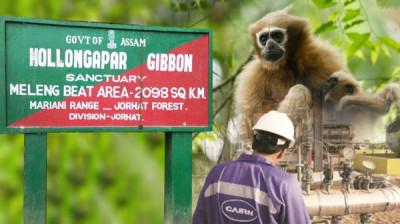
Oil exploration usually involves seismic surveys, test drilling, movement of heavy machinery, creation of access roads, and the laying of pipelines. These activities required clearing parts of forest land, disturbing soil layers, and increasing human presence inside or near sensitive habitats. In the case of the Gibbon Sanctuary, these processes caused habitat fragmentation, which was one of the biggest threats to gibbon populations. Since gibbons depended on continuous tree canopies for movement, even a small break in forest cover could isolate families and restrict their feeding and breeding patterns.
The approval sought by energy companies included using areas within the ESZ for exploratory drilling. Proposals such as the one submitted by Cairn India covered over 4 hectares of reserved forest land. Although preliminary permissions were given, the Forest Advisory Committee later deferred final decisions due to concerns over wildlife disturbance. The committee also asked for a detailed wildlife mitigation plan before further action. In earlier instances, extended reach drilling proposals were rejected based on Supreme Court directives, which restricted mining and drilling within one kilometre of national parks and wildlife sanctuaries.
The potential threat was considered significant because the sanctuary sustained a rich biodiversity. Apart from the hoolock gibbon, the region supported elephants, leopards, slow lorises, macaques, capped langurs, squirrels, reptiles, amphibians, and over 200 bird species. Disturbing this densely intertwined ecosystem meant that even species not directly affected by drilling could face long-term disruptions. Noise pollution from drilling and seismic activity interfered with gibbon duets, which were essential for communication, territory marking, and pair bonding. Constant machinery sound also stressed nocturnal species such as the Bengal Slow Loris.
Experts highlighted that past industrial accidents in Assam, such as the Baghjan blowout in 2020, demonstrated how oil exploration could go wrong, causing massive ecological damage. Although the exploration near the Gibbon Sanctuary had not reached that advanced stage, the possibility of similar accidents made conservationists demand extreme caution.
The sanctuary itself had faced decades of pressure from human activities. A railway line laid during the colonial period continued to pass through the forest, splitting the habitat into sections. Electrification of this railway line, approved later, added further risk. Tea gardens and expanding human settlements surrounded the sanctuary, compressing the movement range of wildlife. In such a shrinking environment, any new activity such as oil exploration increased the vulnerability of the species.
The hoolock gibbon population in the sanctuary was estimated to be around 125 individuals, as per surveys conducted in 2019. Gibbons belonged to one of the oldest ape lineages, and although the western hoolock gibbon was listed as endangered and the eastern hoolock gibbon as vulnerable by the IUCN, genetic studies suggested both populations were deeply related and belonged to the same species. Their survival relied heavily on intact forest cover, abundant fruiting trees, and zero human interference.
The flora of the sanctuary was dominated by towering Hollong trees, along with species such as Nahor, Bhelu, Amari, and Sopas. The dense three-tiered canopy made the forest ideal for arboreal primates. Disrupting this structure for exploration meant a long-term loss of ecological balance, as these trees took decades to mature and replace.
Environmental groups argued that while energy development was necessary, sensitive wildlife areas should not be compromised. The FAC's recommendation for strict safety protocols, erosion control measures, and wildlife management plans showed that the government acknowledged the risks. However, the continuation of such proposals around protected areas remained a concern.
In summary, oil exploration in the Gibbon Sanctuary area was considered a habitat threat because it disrupted forest continuity, created noise disturbances, increased human activity, and risked long-term ecological imbalance. The sanctuary was one of the last strongholds of India's only ape, and protecting its habitat was crucial for safeguarding the remaining population. Conservation-driven decision-making was essential to ensure that industrial activities did not erase decades of ecological protection efforts.