Detailed Notes
Origin and Significance of Tai Ahom Titles
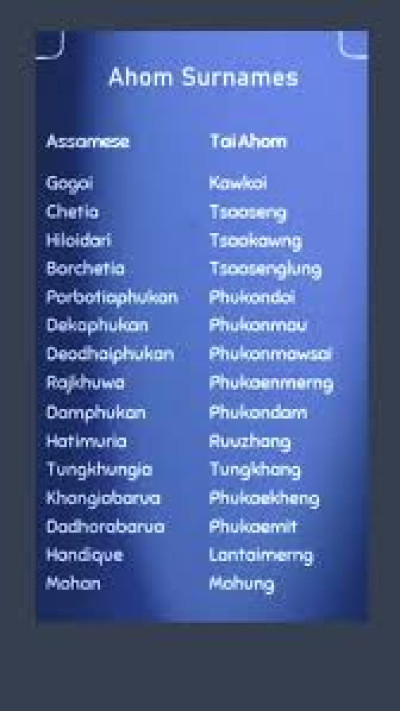
Tai Ahom titles were not honorary labels but functional designations. They clearly indicated a persons rank, duty, and jurisdiction. Over time, many of these titles became hereditary surnames, which are still found among Assamese families today, reflecting their ancestors roles in the Ahom state.
The highest authority was the Chao-Pha, known in Assamese as Roja (King), while the king was also addressed as Swargadeo, meaning the divine ruler. Below the king operated a powerful Council of Ministers (Patra Mantris), which ensured balanced governance and prevented concentration of power.
Core Administrative and Ministerial Structure
-
Borgohain (Chao-Thao-Lung) and Burhagohain (Chao-Phrung-Mung) were the two original great counselors with independent authority and military command.
-
Borpatrogohain (Chao-Ching-Lung) acted as a chief advisor and strategist.
-
Borbarua (Phu-Ke-Lung) and Borphukan (Phu-Kon-Lung) controlled major civil, military, and judicial administration under direct royal supervision.
Paik System and Functional Officers
The Ahom administration relied heavily on the Paik system, a form of organized labor and military service. Titles such as Rajkhowa, Hazarika, Saikia, and Bora represented command over specific numbers of paiks. This system ensured efficient governance, rapid mobilization of resources, and local-level administration.
Linguistic and Cultural Integration
Most royal names and titles began with Su, meaning tiger or greatness, symbolizing strength and divine authority, and often ended with Pha, meaning heaven. As Ahom rulers adopted Assamese-Hindu culture, many Tai titles were translated into Assamese equivalents, preserving meaning while enhancing local acceptance.
Understanding Tai Ahom titles and their meanings is essential for anyone studying Assam history, Ahom administration, medieval governance, or North East Indian heritage, making this topic highly relevant for general knowledge, competitive exams, and academic research.
Tai Ahom Titles and Their Assamese Meanings
Royal and Ministerial Titles
-
CHAO-PHA – King (Roja)
-
CHAO-KHUN – Rajkonwar
-
CHAO-NOI – Konwar
-
CHAO-PHRUNG-MUNG – Burhagohain
-
CHAO-THAO-LUNG – Borgohain
-
CHAO-CHING-LUNG – Borpatrogohain
High Administrative and Military Titles
-
PHU-KE-LUNG – Borbaruah
-
PHU-KE – Baruah
-
PHU-KON-LUNG – Borphukan
-
PHU-KON – Phukan
-
MO-HUNG – Mohan
-
CHANG-BUN – Deodhai
-
MOP-LUNG – Bailung
Specialized Officers and Judicial Roles
-
PHU-KE-MIT – Da-Dhora Baruah
-
CHAO-PO-NGEN – Sodia Khowa Gohain
-
CHAO-MA-RANG-KI – Morongi Khowa Gohain
-
CHAO-MUNG-CHAO-LA – Holal Gohain
Functional and Regional Titles
-
PHU-KE-CHANG-SA-RI – Dulakakhoriyah Baruah
-
PHU-KON-KHA-RI – Dhar Dhoria Phukan
-
PHU-KON-KHU-AANG – Khuwang
-
PHU-KON-KHE – Jalbhari Phukan
-
PHU-KON-PHA-KUT – Dhekial Phukan
-
PHU-KON-PHU-SON-NGIN-NYAI – Hudha Phukan
-
PHU-KON-BAO – Deka Phukan
-
PHU-KON-MA-MU – Tamuli Phukan
-
PHU-KON-MO-SAI – Deodhai Phukan
Revenue, Naval and Local Administration
-
PHU-KIN-MUNG – Rajkhowa
-
LAN-TAI-MUNG – Handique
-
CHAOCHING – Chetia
-
RU-CHAO – Bora
-
RU-PAK (100) – Saikia
-
RU-RING (1000) – Hazarika
Additional Important Titles
-
PHU-KE-CHAO-DANG – Chaodang Baruah
-
PHU-KE-NUK-JIU – Senchuwa Baruah
-
PHU-KON-MAO – No Dhoria Phukan
-
PHU-KON-YAM-SU – Sula Dhora Phukan
-
PHU-KON-RU – Nao Holia Phukan
-
PHU-KON-RAI-DANG – Rai Dongia Phukan
-
PHU-KON-CHI-RING – Chiring Phukan
-
PHU-KON-DOI – Porbotia Phukan
-
LAN-CHONG-KONG – Dihingia
-
CHANG-MAI – Changmai
-
TIAO-SAO – Duwora
-
KUN-PAT / PHU-TU-SEO – Duwori