History & Traditions
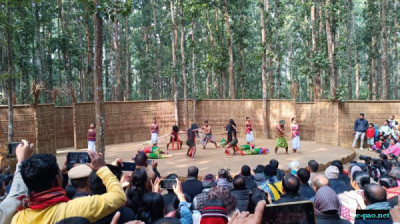
Organised by Badungduppa Kalakendra, the festival has been held annually for over a decade and a half, transforming a forest clearing into a living performance space. Artists perform in daylight, relying solely on voice, movement, and natural acoustics. The absence of technology draws audiences closer to storytelling, physical expression, and the environment, creating an intimate bond between performers, spectators, and the forest.
Origins and Vision of the Festival
The festival began in 2008 under the guidance of Badungduppa Kalakendra, a cultural organisation founded in 1998 by the late Sukracharjya Rabha. His vision was to build a theatre movement rooted in indigenous knowledge systems, physical theatre practices, and ecological awareness. Over time, this vision evolved into the Under the Sal Tree Theatre Festival, now regarded as a landmark example of alternative theatre in India.
From its inception, the festival rejected commercial branding, sponsorship banners, and advertising. It deliberately chose a forest location to emphasize harmony with nature and to remind audiences that art does not need artificial grandeur to be powerful. Mud stages, bamboo seating, and walls woven from thin bamboo strips form the entire infrastructure, reinforcing the idea of sustainability and low-impact cultural practice.
Theatre Without Technology
What truly sets the Under the Sal Tree Theatre Festival apart is its complete rejection of modern theatrical technology. Performances are staged without microphones, electric lighting, spotlights, halogen lamps, recorded music, or special effects. Instead, actors project their voices naturally and rely on expressive body language, rhythm, and silence.
Traditional musical instruments and indigenous props are used sparingly, allowing the forest sounds, rustling leaves, and shifting daylight to become part of the performance. This raw and vulnerable form of theatre challenges performers and audiences alike, making every production unpredictable, intimate, and deeply human.
Indigenous Art Forms and Languages
The festival places strong emphasis on indigenous theatre traditions, languages, and storytelling forms. Rabha, Bodo, and Assamese plays are frequently staged, alongside experimental productions from other parts of India and abroad. This diversity turns the festival into a cultural exchange platform where regional identities are shared without dilution.
Badungduppa Kalakendra is particularly known for its physical theatre style, characterized by minimal dialogue and intense bodily expression. Over the years, its projects such as Ritual Theatre, Performing Identity, Live Theatre, and Retelling Legends Through Theatre have attracted theatre scholars, researchers, and practitioners from across the world to this rural pocket of Assam.
A Community Driven Cultural Movement
The Under the Sal Tree Theatre Festival is not just an event but a community-driven movement. Residents of Rampur village actively participate in preparing the festival grounds, maintaining forest paths, and welcoming visitors. The collaboration between artists and villagers reinforces the idea that theatre can be a shared social responsibility rather than a commercial product.
Despite financial constraints and the absence of corporate sponsorship, the festival continues through collective effort and public goodwill. This resistance to commercialization has preserved the festivals authenticity and kept its focus firmly on art, environment, and cultural integrity.
Environmental Consciousness and Activism
The festival exists in a fragile ecological zone where sal forests face increasing threats from nearby rubber plantations and land-use changes. Under the Sal Tree consciously positions theatre as a form of environmental activism. By drawing audiences into the forest, it builds emotional connections to landscapes that are otherwise ignored or endangered.
Theatre here becomes a means of survival—both for the art form and the forest. The vulnerability of the performances mirrors the vulnerability of the ecosystem, creating awareness through lived experience rather than slogans or campaigns.
National and International Participation
Artists from across India and several countries have performed at the festival, making it an internationally respected theatre gathering. Despite its rural setting, the festival attracts global attention for its originality and philosophical depth. Theatre practitioners view it as a rare space where experimentation, ecology, and tradition intersect without compromise.
Each edition carries a thematic focus, often reflecting retrospection, memory, identity, or coexistence. The festivals silver jubilee edition marked 25 years of theatre innovation and relentless experimentation, reinforcing its role as a cultural institution rather than a seasonal event.
When and Where It Is Held
The festival is usually held in December, most commonly between December 15 and 17, though some editions may be shorter or single-day events depending on circumstances. It takes place in Rampur village, Goalpara district, within a reserved forest area surrounded by sal trees.
Goalpara is well connected by road from Guwahati, making the festival accessible while still retaining its rural, forest-bound character. Visitors are encouraged to respect the natural setting, avoid plastic use, and follow eco-friendly practices during their stay.
Why Under the Sal Tree Theatre Festival Matters
In an era dominated by digital screens, commercial entertainment, and instant gratification, the Under the Sal Tree Theatre Festival stands as a quiet act of resistance. It reminds us that art can survive without spectacle, that communities can nurture culture without corporations, and that forests can be spaces of creativity rather than exploitation.
The festival represents the coexistence of theatre and environment, vulnerability and resilience, tradition and innovation. It is not merely watched—it is experienced, felt, and remembered.
Under the Sal Tree Theatre Festival is not just a celebration of theatre. It is a living dialogue between humans and nature, performed under the open sky of Assam.