History & Traditions
The word Poi originates from the ancient Pali language, meaning tradition, ritual, or ceremonial observance. Among Tai-speaking communities, Poi represents a wide range of religious and social ceremonies connected to different stages of life. These rituals accompany individuals from birth to death, reinforcing the idea that spiritual practices are inseparable from everyday life. Poi-Leng stands out among these ceremonies as a sacred farewell ritual dedicated to a monk who has devoted decades of service to Buddhism.
Spiritual Significance of Poi-Leng
Poi-Leng is observed only when a Buddhist monk who has spent over forty years in monastic life passes away is typically held in early February or March in Assam, often in locations like Charaideo district. Such monks are considered spiritually accomplished, and their death is viewed as a transition toward nirvana, the ultimate liberation from the cycle of birth and rebirth. For this reason, the festival is celebratory rather than sorrowful. Devotees believe that honoring the monk through Poi-Leng helps guide the departed soul toward enlightenment.
Unlike conventional cremation practices, the body of the monk is preserved for seven to eight months after death. Using traditional and scientifically informed methods, the body is placed in a coffin and stored in a specially constructed structure known as Nick Paan Kong. During this period, preparations for the festival begin, involving the entire community.
The Grand Ceremonial Chariot
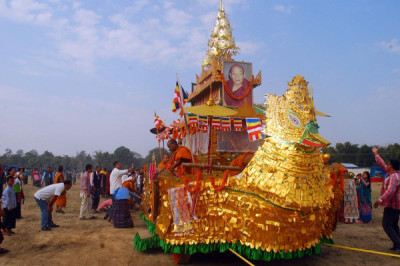
The most striking feature of the Poi-Leng festival is the ceremonial chariot, locally revered as a sacred vehicle. Often designed in a boat-like structure with multiple wheels, the chariot is brightly decorated with traditional motifs, colorful fabrics, and Buddhist symbols. This chariot is constructed specifically to carry the coffin of the departed monk and symbolizes the final spiritual journey toward nirvana.
On the main day of the festival, the coffin is respectfully placed inside the chariot at a temporary sacred venue known as Nibbana-thana. Monks, devotees, and villagers gather to offer prayers, flowers, and incense, paying their final respects.
Ritual Procession and Community Participation
One of the most meaningful rituals of Poi-Leng is the pulling of the chariot by devotees using long ropes from both sides. This act is considered highly virtuous. Participants believe that pulling the chariot brings spiritual merit and offers satisfaction to the departed monk. The procession moves slowly from the Nibbana-thana to the cremation ground, accompanied by traditional Buddhist chants, ceremonial music, and prayers.
The collective participation of the community reflects the strong social bonds among Tai Buddhist groups. The festival strengthens unity, preserves ancestral customs, and passes spiritual values to younger generations.
Cremation and Conclusion of the Festival
Poi-Leng is generally observed over three days, with rituals performed according to Buddhist customs. On the final day, the chariot and the mortal remains of the monk are ceremonially cremated. In some cases, especially when the monk is widely respected, the cremation is conducted with state honors, highlighting the cultural and spiritual importance of the event.
Villages such as Chalapathar Shyam village in Charaideo district and regions of Namsai in Arunachal Pradesh are well known for hosting Poi-Leng festivals. Buddhist monasteries in these areas serve as spiritual centers where traditions are preserved with deep reverence.
Cultural Importance of Poi-Leng in Assam
The Poi-Leng festival represents more than a religious ceremony. It is a living expression of Assam's Tai Buddhist heritage, showcasing how faith, tradition, and community coexist harmoniously. The festival also serves as an educational experience for visitors and researchers interested in indigenous Buddhist practices of Northeast India.
By observing Poi-Leng, the Tai communities reaffirm their belief in compassion, discipline, and spiritual continuity. The festival stands as a reminder that death, when guided by virtue and wisdom, is not an end but a sacred passage.