History & Traditions
Origin and Meaning of Deodhani
The word Deodhani is believed to be derived from two words – Deo, meaning god or divine power, and Dhani, meaning woman or bearer. Traditionally, a Deodhani is a devotee believed to be chosen by the deity to act as a living oracle during the festival. While both men and women may perform, women Deodhanis performing in small groups of three or four are especially prominent in many temple rituals.
The Deodhani tradition is associated with the worship of Goddess Manasa, the serpent goddess linked with fertility, rain, and protection from snake-related calamities. Over time, the ritual also became closely connected with Goddess Kamakhya, the principal deity of the Nilachal Hills and one of the most revered Shaktipeeths in India.
Location and Timing of the Festival
The Deodhani Dance Festival is most famously celebrated at the Kamakhya Temple complex in Guwahati, though similar observances can also be found in parts of Mangaldoi and southwest Kamrup. The festival spans three consecutive days, usually marking the transition from the Assamese month of Shaon to Bhadra. Thousands of devotees and cultural enthusiasts gather at the temple premises each year to witness the sacred performances.
Preparatory Rituals and Spiritual Discipline
Participation in the Deodhani festival requires intense preparation. Selected Deodhanis undergo a month-long period of purification, during which they live within the temple premises, abstain from worldly contact, follow strict dietary rules, and receive guidance from their gurus or priests. This period is believed to prepare the body and mind to receive divine energy.
Devotees carry images or symbols of the deity they are believed to represent. The ritual discipline reinforces the belief that the Deodhani is not merely dancing but is temporarily embodying divine consciousness.
The Deodhani Nritya – The Trance Dance
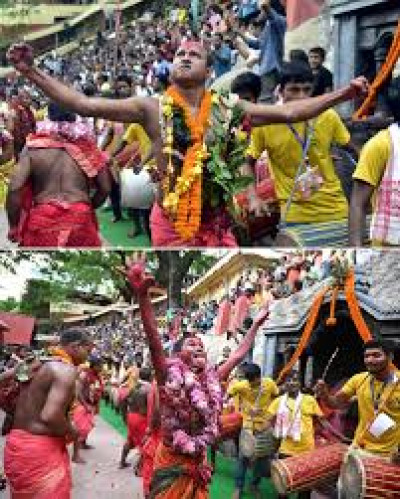
The central attraction of the festival is the Deodhani Nritya, a ritualistic trance performance that is neither fully theatrical nor purely classical. As traditional instruments like the kham or khol (drum), cymbals, and trumpet-like horns echo through the temple grounds, the Deodhanis enter an ecstatic state.
Dressed predominantly in red attire, symbolizing power and fertility, the dancers perform vigorous and spontaneous movements. Many hold ritual objects such as knives, swords, sticks, or shields, and some perform barefoot on sharp edges, demonstrating extraordinary endurance. In their trance-like state, Deodhanis are believed to offer blessings, spiritual guidance, and prophetic insights to devotees.
Rituals Associated with the Festival
The Deodhani Dance Festival is performed alongside Manasa Puja, dedicated to the serpent goddess. Traditional rituals, chanting of mantras, rhythmic drumming, and symbolic offerings form an integral part of the celebration. Historically, animal sacrifices were part of the ritual in certain traditions, though modern observances vary depending on temple customs.
One of the most striking visuals of the festival is the sight of devotees painting their bodies with red vermilion, representing divine energy and devotion. The atmosphere is charged with devotion, mysticism, and rhythmic intensity, making it one of the most unique religious festivals in Northeast India.
Cultural and Historical Significance
The Deodhani Dance Festival is believed to have Bodo-Kachari and pre-Vedic animistic roots, later merging with Hindu Shakti worship. Scholars consider it a living example of Assam's indigenous spirituality, where dance and music function as a bridge between the human and the divine.
Over centuries, the festival has evolved, and today two forms of Deodhani are observed:
-
A trance-based ritual form, performed strictly within religious contexts
-
A refined semi-classical form, presented for cultural preservation and wider appreciation, especially in Mangaldoi and southwest Kamrup
Despite these adaptations, the spiritual essence of the festival remains intact.
Importance in Modern Assam
In contemporary Assam, the Deodhani Dance Festival stands as a symbol of cultural resilience and spiritual continuity. While modern influences have refined certain aspects, the core ritualistic structure continues to inspire devotion and awe. The festival attracts lakhs of visitors, including pilgrims, researchers, photographers, and cultural travelers.
Beyond its religious significance, the Deodhani festival also plays a vital role in preserving Assam's intangible heritage, passing traditional knowledge to younger generations, and strengthening community identity.
Why the Deodhani Festival is Unique
What sets the Deodhani Dance Festival apart is its authentic spiritual intensity. Unlike staged performances, the Deodhani Nritya is believed to be unscripted and divinely guided. Each movement, rhythm, and gesture is an expression of faith rather than choreography, making the festival an unparalleled cultural experience.